Why doubt hurts so much, and why that pain proves nothing?
What the cognitive sciences say about the intuitions that outlive the loss of faith
0. Introduction: a pain that looks like a proof
There is an experience that many people who have left a religion know without daring to name it. You have decided, intellectually, calmly, that you no longer believe. And yet: a surge of anguish at the thought of hell, a physical disgust before a food once forbidden, a crushing guilt at the thought of disappointing a parent. These sensations are so vivid that they look like a message. What if, deep down, the religion was right? What if this unease were the truth calling me back?
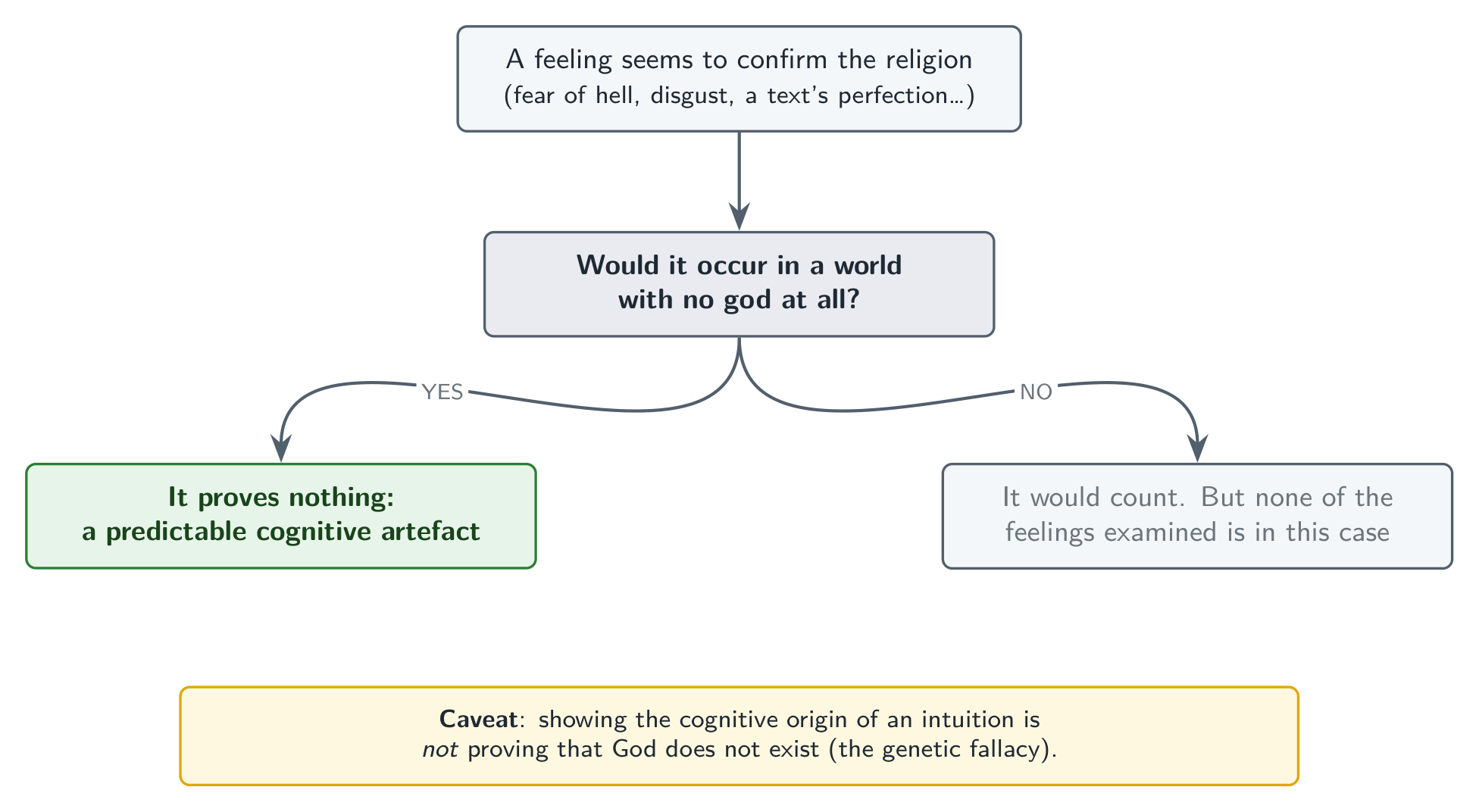
This text defends a simple thesis, and tries to defend it cleanly. These intuitions (the feeling of being watched, the fear of punishment, defilement, the need for cosmic meaning) are not windows open onto the supernatural. They are predictable products of the way the human brain is built. They would fire, identically, in a universe where no god exists. They cannot therefore serve as proof of a religion’s claims (Kahane 2011; Joyce 2016).
A clarification is needed at once, because the confusion is easy and would wreck the reasoning. Showing that a belief has a cognitive origin does not demonstrate that it is false: that would be to commit what philosophers call the genetic fallacy (Kahane 2011; Joyce 2016). Explaining where an intuition comes from does not establish that its content is false. This text therefore does not prove that God does not exist, and does not seek to (Kahane 2011; Joyce 2016). Its ambition is more modest, and more solid: to strip these feelings of their value as proof. An emotion that would be there in any case, whether the belief is true or false, teaches nothing about its truth. Philosophers speak of shifting the burden of proof rather than settling the metaphysics (Kahane 2011; Joyce 2016).
The whole text rests on a test, which we will apply to each feeling: would it also occur in a world where no god exists? If so, that feeling teaches nothing about the truth of the belief, however intense it may be. The chapters that follow review the main intuitions that seem to confirm a religion, and submit them one by one to this question. None, as we shall see, passes it.
The case followed most often will be that of Islam as it is sometimes transmitted, in France, by converted parents, a configuration where the pressure of transmission is particularly strong. It is only an illustration. At each step, the same mechanism holds for other high-control worlds: strict evangelicalism, Jehovah’s Witnesses, certain rigorist Catholic currents. The brain in question is neither Muslim nor Christian: it is the human brain.
The family context, finally, colours everything else. When parents have converted to Islam in adulthood, breaking with their own heritage, the transmission to their children tends to be experienced as a major identity stake; several sociological studies suggest this, though it cannot be generalised (Soehl 2017). The child’s departure is then perceived not as a simple personal journey, but as a charged rupture (Soehl 2017). This weight is real. It is not the subject of this text, but it forms its human backdrop.
1. The brain that sees intentions everywhere
Imagine one of our ancestors on the savannah. A rustle in the tall grass. Two options: “it’s the wind” or “it’s a predator”. To be wrong by believing in the predator costs a needless fright. To be wrong by believing in the wind can cost a life. Over millions of years, such an imbalance of risks favours brains that prefer the cautious error, those that see an agent where there is none (Haselton and Nettle 2006). This is a robust evolutionary logic, known as error management theory (Haselton and Nettle 2006).
From this logic, part of the cognitive science of religion has drawn a seductive hypothesis: we would possess a “hyperactive agency detection device” (HADD), a reflex to attribute invisible intentions to our environment, which religion would exploit to populate the world with spirits and gods who watch us. Elegant and long influential, this idea is today contested: recent reviews stress that after nearly thirty years, it has next to no direct empirical support (Willard et al. 2025; Van Leeuwen and van Elk 2018). We shall therefore mention it as a debated lead, not as an established mechanism.
A neighbouring intuition rests on firmer ground. The developmental psychologist Deborah Kelemen has shown that human beings have a spontaneous propensity to explain the world through purposes: things would be there “for” something. This “promiscuous teleology” is clearly observed in children, and never disappears completely in adults (Kelemen and Rosset 2009). The most striking demonstration lies in one experiment: when adults are pressed to answer quickly, they accept more statements of the type “the sun radiates in order to warm living beings”, including professional scientists, who fall back under pressure onto this default setting (Kelemen and Rosset 2009).
More broadly, the so-called “by-product” approach proposes that religion does not correspond to a dedicated mental organ, but recycles general cognitive mechanisms, present for other reasons (Boyer 2003; Sommer et al. 2023). This is today the dominant theoretical framework, and it remains plausible, provided one notes that several of its star mechanisms, such as the HADD, are themselves weakened (Boyer 2003; Sommer et al. 2023).
There remains the feeling of being watched, so characteristic of religious guilt. Attributing intentions and thoughts to others mobilises a well-identified brain network, involving the medial prefrontal cortex and the temporoparietal junction (van Elk and Aleman 2017). Proponents of the predictive framework (see the next chapter) argue that this same network, over-solicited, would sustain the persistent impression of being judged by an invisible presence, even after faith is abandoned; this is a theoretical extrapolation, not a measured fact (van Elk and Aleman 2017). Here again, the image is that of a circuit designed to read other minds and that keeps running on empty.
The tendency to attribute intentions and purposes to the world stems, at least in part, from the fabric of our mind (Kelemen and Rosset 2009). When an ex-believer interprets an unfortunate coincidence as “a sign”, they are running a mental machinery that would produce the same intuition in a world without heaven. That sign does not pass the test.
Box. What the science says: intentions and purposes
- Hyperactive agency detection (HADD): a hypothesis long central in the cognitive science of religion, today contested for lack of direct empirical support after nearly thirty years (Willard et al. 2025; Van Leeuwen and van Elk 2018).
- Promiscuous teleology: a tendency to explain the world through purposes, well established, persisting into adulthood and reactivated under time pressure, including in scientists (Kelemen and Rosset 2009).
- Theory of mind: the network (medial prefrontal cortex, temporoparietal junction) of intention attribution, solidly established; its link with the “feeling of being watched” remains, for its part, an extrapolation (van Elk and Aleman 2017).
2. The brain that predicts, and that panics when its prediction is contradicted
Why does an abandoned belief keep acting, years after it has been dismissed? An answer comes from a framework that has become central in neuroscience, predictive processing. The brain does not passively await the world’s information: it anticipates it constantly. It can be described, and this is a model rather than a truth carved in stone, as a prediction machine that endlessly seeks to reduce the gap between what it expects and what it perceives (Millidge et al. 2021; Schlicht 2025). Researchers have proposed applying this framework to religion and spirituality; an influential approach, which its own authors present as a set of leads to be tested (van Elk and Aleman 2017).
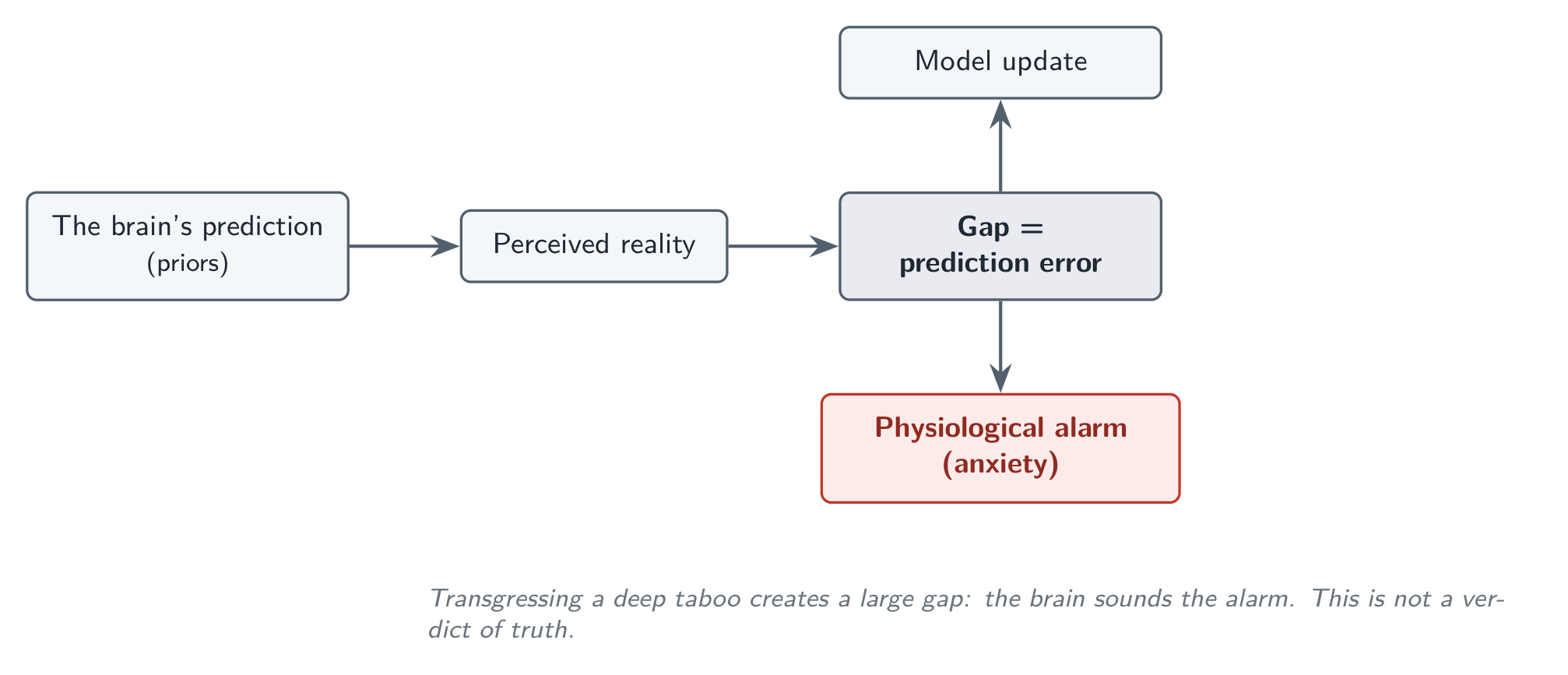
In this language, an early religious upbringing would amount to installing very early some deep, heavily weighted expectations, linking certain thoughts (doubting, transgressing) to catastrophic consequences (sin, damnation). This is a hypothesis consistent with the predictive framework, not a measured fact (van Elk and Aleman 2017). Likewise, the idea that a transgression triggers a “prediction error” experienced as anguish is a seductive inference, which has not been directly tested and must remain cautious (van Elk and Aleman 2017).
Several bricks of this account are, by contrast, solidly established. The anterior cingulate cortex is indeed involved in the detection of conflicts and errors (van Elk and Aleman 2017; Botvinick 2007). The dopaminergic system encodes the gaps between expected and received reward and fixes learned associations, a very well-supported mechanism. The bulk of the evidence, however, concerns reward more than threat, which calls for caution when extending it to “associations of damnation” (Glimcher 2011; Dabney et al. 2020). We know, finally, that uncertainty itself is a state the brain actively seeks to flee: “intolerance of uncertainty” is one of the factors most regularly associated with anxiety (McEvoy et al. 2019). Religious doubt is therefore not a mere problem of ideas; it is a state that the nervous system treats as uncomfortable.
The decisive point for the thesis lies elsewhere, and it is a matter of analogy more than of demonstration. When one learns to fear something, then “unlearns” this fear, the initial trace does not really vanish: it is overlaid by a new, more fragile learning (we return to this in chapter 5). By analogy, it is plausible that old religious expectations keep influencing affect and the body even after the conscious rejection of the belief, without this having been directly measured for religious content (Giustino and Maren 2015). If so, the anguish of transgression is the signature of an internal conflict between old settings and new convictions. It would occur in anyone who received the same early conditioning, in a world without a god as in any other: it does not pass the test.
Box. What the science says: predictive processing
- Predictive framework (“Bayesian brain”): the dominant framework of cognitive neuroscience, but theoretical; one says the brain is modelled as a prediction-error minimiser, not that it is a Bayesian machine (Millidge et al. 2021; Schlicht 2025).
- Application to religion: proposed as a framework to be tested, not as a result (van Elk and Aleman 2017).
- Solid bricks: dopaminergic coding of prediction error (Glimcher 2011; Dabney et al. 2020); the role of the anterior cingulate cortex in error detection (van Elk and Aleman 2017; Botvinick 2007); intolerance of uncertainty as a transdiagnostic factor of anxiety (McEvoy et al. 2019).
- Cautious inferences: the link between early religious priors and the anguish of transgression remains untested directly (van Elk and Aleman 2017).
3. The brain that decrees “impure”
Here is one of the most disconcerting symptoms. A person who has left Islam may “know” perfectly well that pork is an ordinary meat, and still feel a physical aversion at its approach. The same structure is found elsewhere: a former member of a strict community cannot shake off an unease before a gesture, a garment or a word once forbidden.
The most solid first. Disgust is, originally, a defence system against pathogens: it keeps us away from spoiled food, poisons, sources of disease (Oaten et al. 2009; Curtis et al. 2011; Cepon-Robins et al. 2021). It is one of the best-established results in the psychology of emotions, confirmed even by field data linking disgust sensitivity and lower infection (Oaten et al. 2009; Curtis et al. 2011; Cepon-Robins et al. 2021). We also know that this sensitivity sets in early in life, and that it is transmitted in part within the family (Kaňková et al. 2025).
The draft from which this text grew went much further: it claimed that “physical” disgust and “moral” disgust mobilise exactly the same brain region, and that religions “graft” the prohibition onto this circuit to make it indelible. Caution is required here, for the recent literature is markedly less assertive.
The brain overlap, first, is partial, not total. Imaging meta-analyses show that disgust at a repugnant food and disgust at a social transgression share certain regions, notably the anterior insula, but also recruit distinct networks (Gan et al. 2022, 2024). One can therefore speak of a partly common substrate, not of a single circuit (Ying et al. 2018; Gan et al. 2022).
More troubling for the usual account, the idea of a moral domain of “purity” welded to disgust is today seriously contested. An influential critical review concludes that “purity” is not a coherent concept and cannot be specifically linked to disgust (Gray et al. 2023). Likewise, the long-repeated claim that an incidental disgust makes our moral judgements harsher does not withstand scrutiny: the reference meta-analysis shows that the effect, already weak, vanishes once publication bias is corrected for (Landy and Goodwin 2015). We therefore set aside this claim, rather than repeating it.
What remains to explain the persistent aversion to pork? A plausible mechanism, to be presented as a hypothesis and not as a demonstration. Conditioned food aversions are, in the laboratory, remarkably durable and resistant to extinction (Nakai et al. 2020; Bouton and Michaud 2022). It is therefore reasonable to think that an aversion installed in childhood may long outlive the intellectual rejection of the dogma. Two reservations, however, are needed: this type of conditioning ordinarily rests on nausea, not on a moral prohibition, and no study has directly examined the case of pork in former believers (Nakai et al. 2020; Bouton and Michaud 2022). The idea that “purity codes condition a durable somatic aversion” therefore keeps the status of a cautious hypothesis (Curtis et al. 2011; Gray et al. 2023).
This aversion, whatever its exact mechanics, is at best the trace of a learning. It does not “indicate” that a food is really impure, any more than the nausea of someone once poisoned indicates that a healthy dish is poisoned. It would appear in anyone who underwent the same conditioning, belief or not: it does not pass the test.
Box. What the science says: disgust
- Anti-pathogen origin: well established, disgust is a defence system against disease (Oaten et al. 2009; Curtis et al. 2011; Cepon-Robins et al. 2021).
- Physical and moral disgust: a partly common substrate (anterior insula), but also distinct networks; not a “single circuit” (Gan et al. 2022, 2024; Ying et al. 2018).
- Purity and disgust: a contested link, “purity” being a poorly coherent construct, not specifically attributable to disgust (Gray et al. 2023; Curtis et al. 2011).
- Disgust and moral severity: the idea of a worsening is set aside, the effect vanishing after correction for publication bias (Landy and Goodwin 2015).
- Aversion to pork: a hypothesis (durable conditioned taste aversion); no direct study on former believers (Nakai et al. 2020; Bouton and Michaud 2022).
4. The brain that confuses fluency with perfection
There is an argument that many believers feel to be unanswerable: this text is so beautiful, so perfect, that no human could have produced it, so it must come from elsewhere. In Islam, this intuition has a name, i’jaz, the inimitability of the Quran. It is found everywhere: the faithful who hold the King James Bible to be an unsurpassable perfection of the English language, the listener overwhelmed by a Vedic recitation in Sanskrit, the lover of sacred music seized by a Miserere. The feeling is universal; it therefore deserves an explanation that depends on no religion in particular.
Now this feeling of perfection is one of the most predictable that cognitive psychology knows how to produce. Three mechanisms, well documented, are enough to manufacture it.
The first is processing fluency. The easier a piece of information is to process, the more it seems to us both true and beautiful. On the side of truth, this is the “illusory truth effect”: a repeated assertion is judged truer than a new one, and this happens independently of its actual truth (Hassan and Barber 2021; Unkelbach and Rom 2017). A reanalysis of nearly thirty thousand judgements confirmed it: repetition inflates the feeling of truth and confidence, whether the statement is factually true or false (Hassan and Barber 2021; Unkelbach and Rom 2017). On the side of beauty, the finding is the same: according to a very well-established theoretical framework, aesthetic pleasure depends in large part on the ease with which the perceiver processes the object, “beauty is in the processing experience of the beholder”, more than in the object itself (Reber et al. 2004; Yoo et al. 2024).
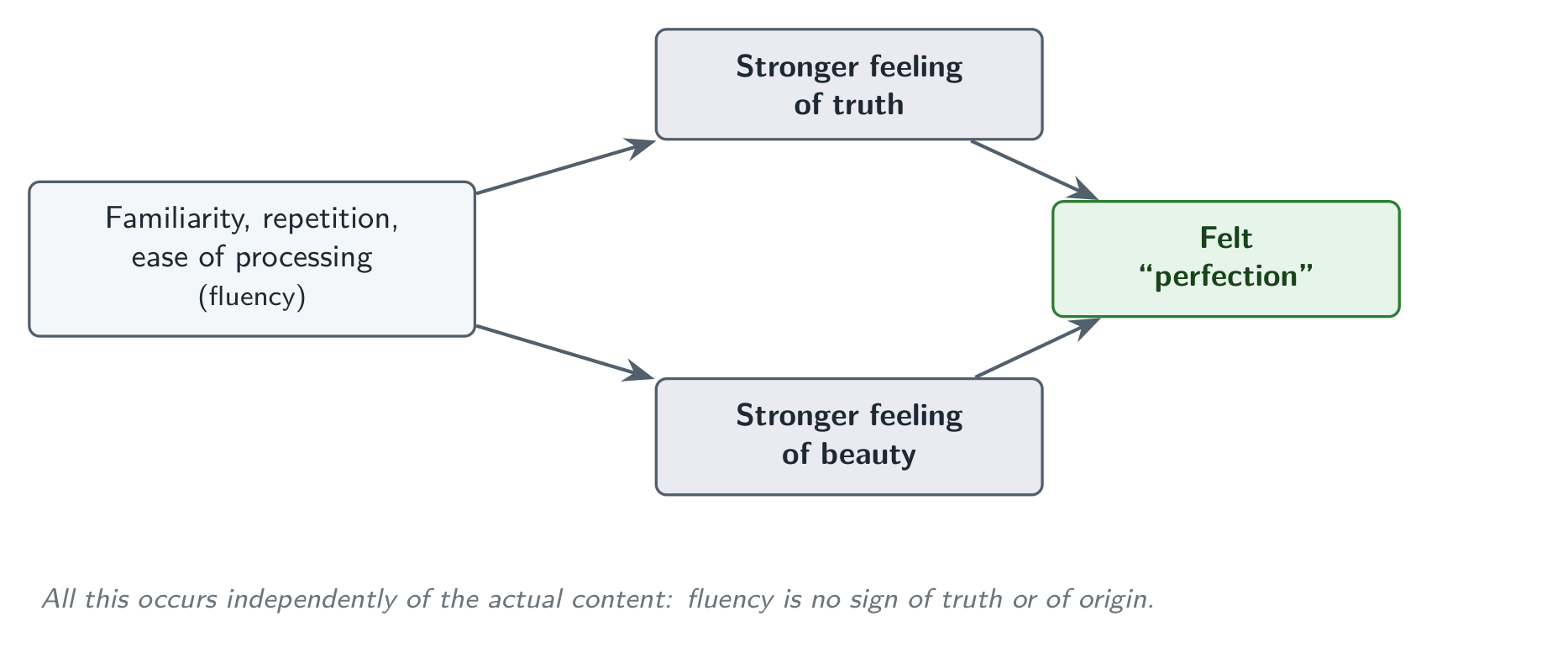
The second mechanism is the mere-exposure effect. Being repeatedly exposed to a stimulus increases, on its own, the liking one has for it; it is one of the best-replicated regularities in psychology (Montoya et al. 2017). Now a text recited from early childhood, thousands of times, in a solemn setting, constitutes massive exposure par excellence. The love one bears it does not require the text to be objectively perfect: exposure suffices, independently of content (Montoya et al. 2017).
The third is sacralisation. Knowing in advance that an object is precious modifies the experience one has of it, and not only the judgement one reports: the pleasure actually felt changes. When tasters are made to believe that a wine is expensive, they find it better and their orbitofrontal cortex, the seat of experienced pleasure, activates more, although the wine is identical (Plassmann et al. 2008; Schmidt et al. 2017). Expectation sculpts perception from the top down (Plassmann et al. 2008; Schmidt et al. 2017). Approaching a text with the certainty that it is the word of God works like an infinitely high price tag: one perceives perfection before even reading.
Combined, these three forces (fluency, exposure, sacralisation) produce almost mechanically a feeling of unsurpassable perfection. This feeling would occur identically whether the claim of divine origin is true or false: it does not pass the test (Kahane 2011). The safeguard holds here as elsewhere: we explain why the feeling is so strong, without thereby refuting the theological thesis (Kahane 2011).
There remains a modern objection: with today’s computing power, could one not measure inimitability? No, and for a reason of principle. The i’jaz that scholars defend does not reduce to the feeling of beauty treated above: it makes a factual claim about properties of the text, its style, its composition, its unity of authorship. It is precisely for that reason that one answers it on the ground of stylometry, rather than dodging the strong argument with a test bearing on feeling alone (Neal et al. 2017; Eder 2015; Rosa 2025). The tools of statistical style analysis (stylometry) can compare writing signatures and estimate the unity of authorship of a corpus, but they measure neither the beauty nor the origin of a text: those are questions outside their domain (Neal et al. 2017; Eder 2015; Rosa 2025). A recent analysis of the Pauline corpus says it bluntly: lacking authentic reference texts, these methods cannot settle “fundamentally epistemological” questions such as that of origin (Neal et al. 2017; Eder 2015; Rosa 2025). To this is added a material limit: below a few thousand words, the results become unstable, and many sacred texts are too short for a firm conclusion (Neal et al. 2017; Eder 2015; Rosa 2025). No computing power changes that, for the lock is epistemological, not computational: beauty and origin escape statistical measurement by their very nature.
Box. What the science says: fluency, familiarity, perfection
- Illusory truth: repetition increases the feeling of truth, independently of the true (Hassan and Barber 2021; Unkelbach and Rom 2017).
- Fluency and beauty: ease of processing feeds aesthetic pleasure (Reber et al. 2004; Yoo et al. 2024).
- Mere exposure: repeated exposure increases liking (Montoya et al. 2017).
- Expectation and perception: a prestige label modifies the pleasure felt, at the neural level (Plassmann et al. 2008; Schmidt et al. 2017).
- Stylometry: measures the signature and the unity of authorship, not beauty nor origin; limited by corpus length (Neal et al. 2017; Eder 2015; Rosa 2025).
- Scope: explains the feeling of inimitability; does not refute the theological thesis (anti-fallacy) (Kahane 2011).
5. When leaving wounds: the imprint of fear
So far, the test has disqualified the intuitions that seemed to plead for religion. There remains the most tenacious, and the most painful: the very suffering of leaving. The fear of hell, the terror of having been wrong, the feeling of having lost everything are real and sometimes disabling. Their existence, here again, has nothing mysterious about it; it even has a partly recognisable clinical signature.
Let us begin with the vocabulary. One often hears talk of “Religious Trauma Syndrome”. This term, proposed in 2011, appears in no official diagnostic manual (neither DSM-5 nor ICD-11) and rests on a limited empirical base (Winell 2011; Ok et al. 2024). Equating it with post-traumatic stress disorder is a clinical practice, not a validated equivalence (Ok et al. 2024). There exists, on the other hand, a more cautious and measurable notion, spiritual harm: recent scales, validated on large samples, show that adverse or abusive religious experiences are associated with poorer mental health (Koch and Edstrom 2022). It is this measurable version, and not the unrecognised “syndrome”, that we retain here.
To this is added the social cost, often underestimated. Breaking with one’s community of origin is not only changing one’s mind: it is risking exclusion from the group that structured a whole life. Now the pain of social exclusion is, psychologically, a major cost, which mobilises in part circuits close to those of physical pain, a real overlap even if its neural detail remains debated (Eisenberger 2012; Macdonald and Leary 2005). The apostate’s distress corresponds to the expected response of a social animal threatened with isolation.
The fear of leaving, or exclusion as a tool
This pain of exclusion is not only a side effect of departure: in high-control groups, it is an instrument. Ostracism is a well-documented mechanism for regulating norms; to exclude, or to threaten exclusion, drives conformity and preserves the cohesion of the group (Rudert et al. 2023; Eriksson et al. 2021; Ransom et al. 2020). Several traditions have made it a formal procedure: the disfellowshipping of Jehovah’s Witnesses, the Jewish herem, the Amish Meidung, takfir among certain Muslim fringes. The mainspring is everywhere the same, to raise the cost of leaving to the point of making it almost unthinkable. And this cost is real: studies of former “shunned” Jehovah’s Witnesses document a lasting effect on mental health, self-esteem and well-being (Rudert et al. 2023; Eriksson et al. 2021; Ransom et al. 2020).
For those who doubt, this produces a particular terror: no longer only the fear of hell, but that of losing one’s own. This terror combines two mainsprings already encountered, the pain of social exclusion (Eisenberger 2012; Macdonald and Leary 2005) and the conditioned fear of punishment (Giustino and Maren 2015; Mavrych et al. 2025), mobilised by the community apparatus. It measures the effectiveness of a tool of social control; it does not indicate that the group holds the truth. Resorting to threat to retain its members documents the group’s means of coercion, and remains without bearing on the validity of its claims.
The clearest face of this suffering bears a clinical name, scrupulosity. It is a well-documented subtype of obsessive-compulsive disorder, organised not around microbial dirt but around moral and religious anguish (Greenberg and Huppert 2010). Its mechanics are typical of OCD: obsessions (“what if I am wrong? what if I burn for eternity?”) feed compulsions (checking, ruminating, endlessly seeking reassurance) (Greenberg and Huppert 2010). The same pattern strikes former evangelical Christians haunted by “damnation”, a sign that the engine is the disorder, not the particular doctrine. A point of accuracy: being raised in religion is not demonstrated to be a cause of OCD; scrupulosity is a form the disorder takes, not an illness that faith would mechanically produce (Greenberg and Huppert 2010).
Science offers here, in addition to an explanation, a way out. The reference treatment for OCD is exposure with response prevention (ERP): one exposes oneself voluntarily and gradually to the dreaded thought, without giving in to the rituals of reassurance (Reid et al. 2021; Song et al. 2022). Two honest nuances: ERP is highly effective against a placebo or a medication, but has not shown superiority over other active psychotherapies (Reid et al. 2021; Song et al. 2022), and the data specific to scrupulosity remain limited (Reid et al. 2021; Song et al. 2022). Its principle, above all, illuminates the whole thesis. ERP does not work by rationally proving to the patient that hell does not exist: seeking this proof, like seeking reassurance, only sustains the obsessional cycle (Rector et al. 2019). It works through a new learning, when the nervous system finally observes that no danger occurs and the alarm dies down on its own (Weisman and Rodebaugh 2018).
If reasoning does not suffice, it is because conditioned fear passes largely through the amygdala, a fast system fairly independent of reasoning (Giustino and Maren 2015; Mavrych et al. 2025). And “extinguishing” a fear does not erase the initial trace: extinction is a new and fragile learning, which demands exposure, not only conviction (Giustino and Maren 2015). One can therefore “know” that hell does not exist and tremble all the same. This trembling is a learned reflex that has not yet been unlearned. It would occur in any brain conditioned in this way: the pain of leaving, too, does not pass the test.
Box. What the science says: distress, OCD and treatment
- “Religious Trauma Syndrome”: not recognised (absent from DSM-5 and ICD-11), limited empirical base (Winell 2011; Ok et al. 2024). Measurable and defensible version: spiritual harm, equipped with validated scales (Koch and Edstrom 2022).
- Social pain of exclusion: a robust psychological cost; neural overlap with physical pain real but debated (Eisenberger 2012; Macdonald and Leary 2005).
- Organised ostracism: a tool for controlling norms, whose shunning lastingly harms ex-members (Rudert et al. 2023; Eriksson et al. 2021; Ransom et al. 2020).
- Scrupulosity: a documented subtype of OCD; note that religion is not demonstrated to be a cause of OCD (Greenberg and Huppert 2010).
- Exposure with response prevention (ERP): a validated treatment for OCD, effective against placebo and medication but not superior to other active therapies; acts through inhibitory learning, not through persuasion (Reid et al. 2021; Song et al. 2022; Weisman and Rodebaugh 2018).
6. The heart of the argument: why none of this is probative
The verdict, now. Each feeling reviewed has failed the same test: the feeling of being watched, the fear of punishment, the disgust at the forbidden, the impression of a text’s perfection, the very pain of leaving. All would occur identically in a universe without any god, for they flow from the cognitive architecture, not from the object of the belief (Kahane 2011; Joyce 2016).
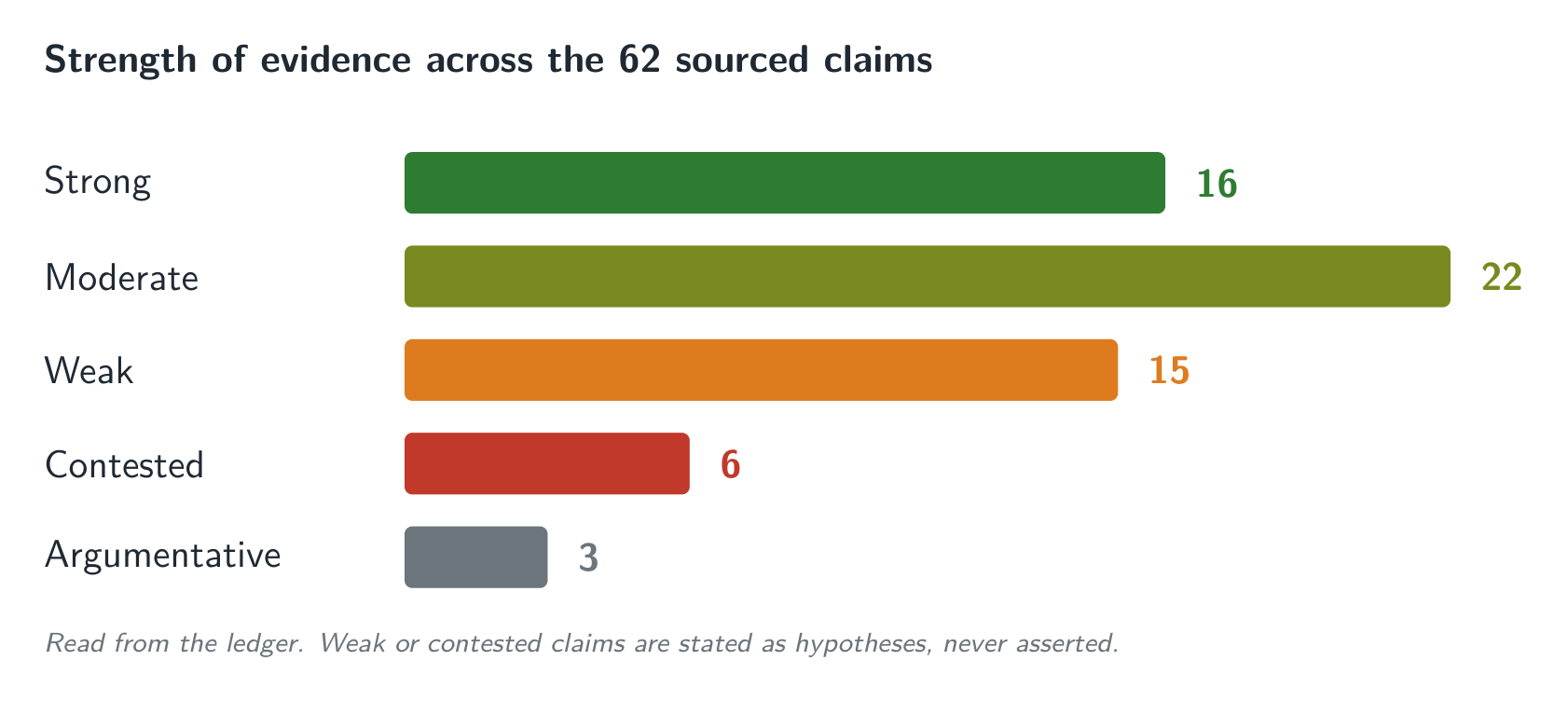
This inequality of solidity, the text owns it: each claim has been graded according to the real strength of the available evidence, and the most fragile are presented as hypotheses, never as facts.
Now a datum that would appear in any case, whether the belief is true or false, does not allow one to decide between the two. This is the proper form of the argument, which philosophy knows under the name of “debunking arguments”: showing that a belief is explained by a process blind to truth strips that belief of its justification, and shifts the burden of proof onto the one who asserts it (Kahane 2011; Joyce 2016). Feeling the fear of hell therefore provides no information about the existence of hell.
This argument is handled with care, and the philosophical literature itself requires it. These reasonings have limits: they hold only under certain conditions, and pushed too far, they “prove too much”, to the point of undermining even our ordinary beliefs (Kahane 2011; Joyce 2016). The guard lies in one criterion, which must be stated so as not to cheat. Such an argument bites only if the mechanism in question is insensitive to the truth of what it asserts, that is, if it would fire identically whether the thing is true or false. Vision is not in this case: in a room without a table, I do not see a table, my perception tracks the world. The feeling of being watched, by contrast, fires on a creaking floorboard whether or not there is someone behind the door; it tracks the state of our brain, not the state of the world. It is this insensitivity, and it alone, that strips away the value as proof. It is also why the argument turns neither against perception, nor against mathematics, nor against the reasoning of the present text, which we have independent reasons to think track their object (Kahane 2011; Joyce 2016). Hence the modest version retained here. We do not say: “these intuitions have a cognitive origin, therefore God does not exist.” That would be the genetic fallacy already set aside in the introduction (Kahane 2011; Joyce 2016). We say only: these intuitions do not count as proofs. They weigh nothing in the balance of true and false. The metaphysical question, for its part, remains entire, and this text leaves it explicitly open (Kahane 2011; Joyce 2016).
The practical consequence is nonetheless considerable for those who doubt. The distress felt at the moment of leaving is not a signal of truth that should be heeded. It is an artefact of our physiology. One can pass through it without taking it for a verdict.
Box. What philosophy says: debunking arguments
- Form of the argument: showing that a belief results from a process blind to truth strips its justification and shifts the burden of proof, without establishing its falsity (Kahane 2011; Joyce 2016).
- The criterion that avoids “proving too much”: the argument bites only if the mechanism is insensitive to truth (it fires whether the thing is true or not); perception and mathematics, which track their object, are therefore not touched (Kahane 2011; Joyce 2016).
- Perimeter: we judge the probative value of intuitions, not the philosophical arguments for God (cosmological, contingency, moral), which fall under a different examination (Kahane 2011; Joyce 2016).
- Safeguard: to conclude from origin to falsity would be a genetic fallacy; the text takes no position on the existence of God (Kahane 2011; Joyce 2016).
7. The way out: meaning without the dogma
The argument stops at the verdict of the previous chapter. What follows is no longer a demonstration but a proposal, for those wondering how to live afterwards. There remains a legitimate fear: if one removes the religious scaffolding, is there nothing left but a void? The human being has a real need for meaning and structure, which religions have long filled (3rd et al. 2010). Yet several of the functions thought reserved for the religious are accessible otherwise, and science is beginning to document it.
The best-studied path is awe, that emotion one feels before something so vast, perceptually or conceptually, that it forces the mind to enlarge its frames (Monroy and Keltner 2023). Its effects are beginning to be measured. One study suggests that awe diminishes the sense of self-importance and increases generous and cooperative behaviours, independently of people’s degree of religiosity, which makes a simple “hidden” effect of faith unlikely (Piff et al. 2015). It also seems associated with an improvement in well-being and a reduction of stress, including in vulnerable populations such as veterans or struggling young people, even if this work remains as yet scarce (Monroy and Keltner 2023; Anderson et al. 2018). And it is reached by secular and reproducible routes: immersion in nature is the best documented, but music or collective movement also count (Monroy and Keltner 2023; Anderson et al. 2018).
Two frequent exaggerations are to be set aside, for the safeguards hold for our own camp too. One often reads that awe “spectacularly deactivates” the brain’s default mode network, that of self-rumination. The reality is more modest: one study suggests a decrease in self-focused processing during awe, but the effect is explained in part by attentional absorption, and a single study does not make a certainty (van Elk et al. 2019). The link between this network, rumination and depression is, for its part, well established, but it passes through details of connectivity more subtle than a simple “hyperactivity” (Hamilton et al. 2015; Zhou et al. 2020). As for “ego dissolution”, it is documented above all under psychedelics, and does not transpose without caution to ordinary awe (Lebedev et al. 2015; Siegel et al. 2024). Finally, while an awe trait has been linked to lower inflammation, the idea that it would release oxytocin or act on vagal tone is not supported by the available sources, and is therefore not asserted here (Stellar et al. 2015).
Two resources complete the picture. The first is the cosmic narrative: understanding that the carbon, oxygen and iron atoms that compose our body were forged in the hearts of stars and dispersed by their explosions is not a poetic metaphor but a fact of astrophysics (Arcones and Thielemann 2022). We are not fallen creatures cast upon Earth to be judged there; we are, literally, stardust become capable of contemplating itself. The second is ritual, which does not depend on the supernatural to function. Marking solstices, births, bereavements answers a real need for belonging and bearings (Hobson et al. 2018); and rituals, even secular, reduce anxiety, through a real though modest effect (Lang et al. 2020; Hobson et al. 2018).
One question remains: without God, on what to base morality? On what we are. Cooperation, empathy, the sense of fairness have deep evolutionary roots and require no supernatural foundation to exist (Tomasello and Vaish 2013; Purzycki et al. 2016). In honesty, a nuance: believing in moralising and punishing gods has, historically, been able to help extend cooperation to large groups of strangers (Tomasello and Vaish 2013; Purzycki et al. 2016). Recognising this past social role does not imply that it must be maintained: these cooperative dispositions subsist independently of belief in God (Tomasello and Vaish 2013; Purzycki et al. 2016).
Box. What the science says: awe and its substitutes
- Prosocial effects: suggested by one study, awe would diminish the sense of self-importance and would increase generosity, independently of religiosity (Piff et al. 2015).
- Well-being: associated with a reduction of stress and an improvement of well-being, including in vulnerable populations; work still scarce (Monroy and Keltner 2023; Anderson et al. 2018).
- Default mode network: the decrease in activity during awe is modest and disputed (van Elk et al. 2019). “Ego dissolution” is documented above all under psychedelics and does not transpose without caution (Lebedev et al. 2015; Siegel et al. 2024).
- Physiology: only the link between awe and lower inflammation (IL-6) is supported; vagal tone and oxytocin are not supported by the sources and are not asserted here (Stellar et al. 2015).
- Psychedelics: supervised clinical trials show benefits on anxiety and depression in serious illness, mediated by the mystical experience; a result not to be generalised to everyday awe (Griffiths et al. 2016; Ross et al. 2016).
- Secular ritual and morality: a real but modest anxiolytic effect of rituals (Lang et al. 2020; Hobson et al. 2018); evolutionary roots of moral cooperation, with no supernatural foundation required (Tomasello and Vaish 2013; Purzycki et al. 2016).
8. Conclusion: shifting the burden, from guilt towards understanding
Our mind is so made that it avidly seeks causes and intentions, and that it dreads above all exclusion from the group, two dispositions a part of which is inscribed in our evolutionary history (Eisenberger 2012; Kelemen and Rosset 2009). These dispositions have a troubling consequence: they manufacture, in those who move away from a high-control religion, sensations so intense that they imitate the voice of truth.
To free oneself does not consist in proving to oneself, through reasoning, that these sensations are false; we have seen it, that does not suffice and can even feed the obsession. To free oneself is to change what one reads in these sensations. Fear, disgust, guilt are not verdicts on reality; they are phenomena of our physiology, predictable and explicable. Understanding this does not make the pain disappear at once, for deconstruction is also a slow biological labour (Giustino and Maren 2015). But it shifts the burden: from the guilt of having “acted wrongly” towards the calm understanding of how one is built.
This shift is not a metaphysical victory. This text does not conclude, and cannot conclude, to the non-existence of God (Kahane 2011; Joyce 2016). It concludes something surer and, for those who doubt, more useful: that the suffering of departure proves nothing, and that one can therefore pass through it without taking it for a sign. It is a form of sovereignty: taking back control over the meaning one gives to one’s own inner states.