Is sorting your waste really worth it?
A material-by-material inquiry: what the gesture changes, what it does not, and why the answer depends as much on the matter as on the country
0. Introduction: the doubt over the bin
You are holding an empty bottle over the sorting bin. A hesitation passes, then the little voice: what is the point, it all ends up mixed anyway, the plant sorts it for me, and meanwhile a handful of multinationals dump more in an hour than my neighbourhood does in a year. The gesture feels trivial. You rinse a yogurt pot, flatten a box, separate the glass, and you end up wondering whether all this is a play you are staging for yourself. Many of us sort out of habit or civic duty, with the dull conviction that it weighs nothing.
This intuition deserves better than a reflex answer, in either direction. Sorting has a real environmental value, but an unequal one, and how that value is shared depends on two precise variables: the material you sort and the country where you sort it. An aluminium can and a soft plastic film do not have the same story; a Swiss bin and a skip dropped in a country with no proper channel do not either. What follows seeks neither to reassure you nor to accuse you, but to establish where the gesture pays, where it is doubtful, and why.
A first methodological caution, because it governs everything else. The question “is it worth anything” is not a matter of feeling to be settled by asking where the doubt comes from: it is a question of fact, settled head-on, with figures and balances. This time, the starting point is a measurement to verify, not an emotion to examine, which changes the tool. We will not ask whether the doubt is legitimate, but whether it is accurate.
A second caution, symmetry, which will be the thread of the whole text. Showing that the gesture is modest or unequal does not establish that you should stop sorting; and showing that you should sort does not establish that sorting is enough, nor that every gesture counts as much as any other. The two errors are twins, and each suits whoever makes it: the first excuses inaction, the second excuses thinking. The triumphalism of recycling and the cynicism of giving up resemble each other more than they believe, for both replace case-by-case examination with a convenient formula.
We must also defuse at once the argument that often closes the discussion. “Only the big polluters count, so my gesture is useless” has the form of an obvious truth, and it is a fallacy: the smallness of a contribution does not demonstrate its uselessness, and the systemic and individual scales do not exclude each other. One can hold both ends, demand better rules and sort what deserves it, without one cancelling the other. We will return to it once the facts are laid out, for this argument can be refuted, not merely asserted.
One last figure to set the scene. Switzerland is among the countries that produce the most municipal waste per capita in Europe, while posting one of the best recycling rates: sorting well and throwing away a lot coexist without difficulty, and sorting never corrects what was produced upstream (Manfredi and Goralczyk 2013; Eurostat 2023). There is the first crack in the idea that sorting would solve the problem: one can be an excellent sorter and a heavy producer of waste, and that is precisely the Swiss case.
Let us state the scope. This text is about household sorting of the common streams, aluminium, glass, paper and board, PET, mixed plastics, metals, taking Switzerland as the main case and comparing it with its neighbours. It leaves aside industrial, construction, electronic and organic waste, as well as the legal detail of producer responsibility, each of which calls for its own examination. The inquiry is deliberately narrow, in order to stay verifiable.
1. The myth of the plant that sorts for you
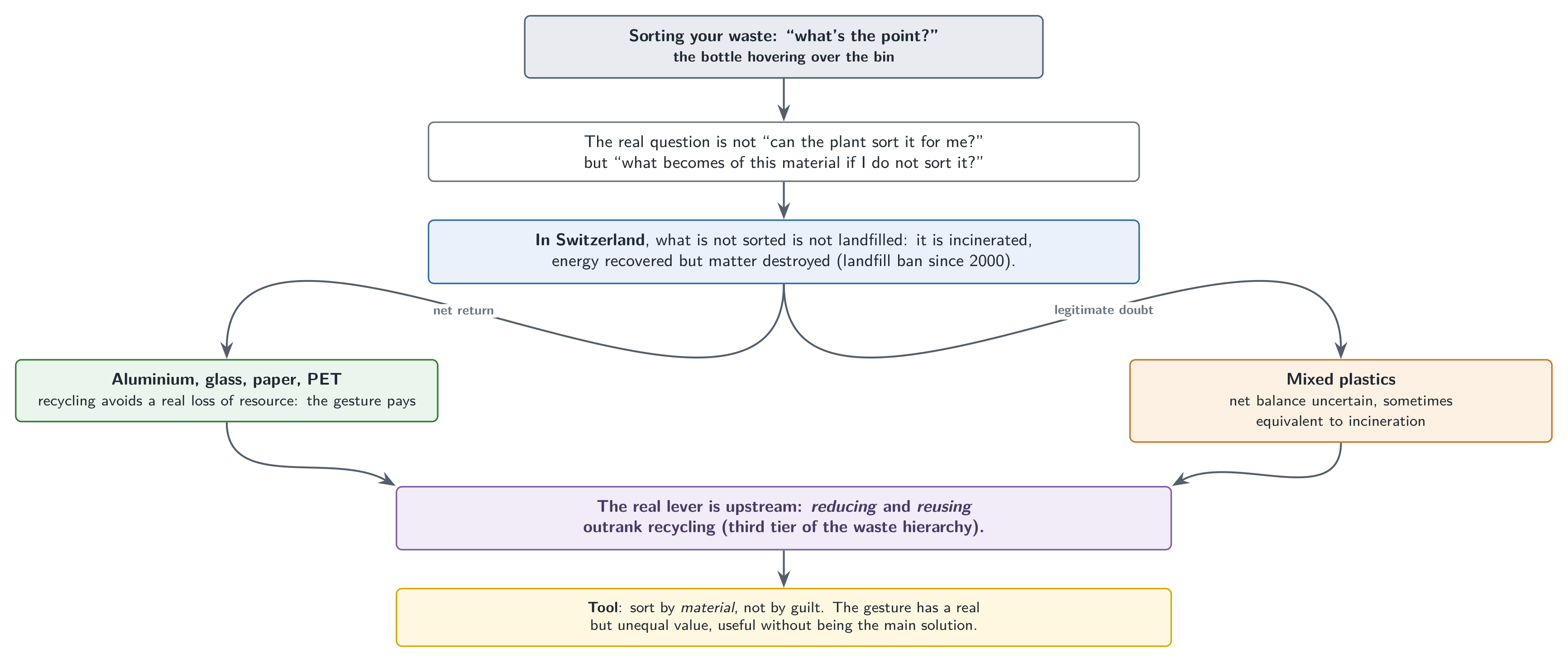
The image that feeds the doubt is that of a plant where machines untangle, in your place, the contents of a single bin. That image is not invented: it fits some countries, which rely more on downstream sorting centres. But it describes Switzerland badly, where the system rests on sorting at the source by the household rather than on a mechanical untangling of mixed waste, unlike the German dual system (Manfredi and Goralczyk 2013; Office federal de l’environnement (OFEV), Suisse 2023). Here the citizen’s gesture is not a supplement to industrial sorting: it is the first step, and often the only one. If you do not separate your glass, no machine downstream will do it for you.
What is not sorted then follows a path quite different from the imagery of the open dump. Since 1 January 2000, landfilling combustible municipal waste has been banned in Switzerland: what you do not sort is not buried, it is incinerated in a plant that recovers its energy (Office federal de l’environnement (OFEV), Suisse 2000; Turconi et al. 2011). The fate of your grey rubbish is therefore not slow burial, but the furnace. Sorting at the source directly governs the split between recovered material and burned material, and in Switzerland this split puts about half of municipal waste into recycling or composting, the other half into incineration, it being understood that this half measures what is diverted towards those channels and not the material actually recycled at the end of the chain, the distinction of the next paragraph (Manfredi and Goralczyk 2013; Office federal de l’environnement (OFEV), Suisse 2023). What you put in the right bin tips to the recovered side of that line, the rest goes to the furnace.
This incineration deserves to be looked at squarely, neither demonised nor idealised, because it is the real alternative to your gesture. It does recover energy, as heat for district heating networks and electricity for the grid, which is a real recovery and not mere destruction (Turconi et al. 2011; Office federal de l’environnement (OFEV), Suisse 2023). But it destroys the material, and that is where everything is decided: for aluminium and metals, burning amounts to losing a resource that will have to be re-extracted at great cost, whereas for some difficult plastics the trade-off is more defensible (Turconi et al. 2011). The real question is therefore not whether the plant can sort for you, but whether it is better to recycle a given material or to burn it for its energy. The answer, as we will see, changes entirely with the matter, and that is the whole object of the inquiry.
One more word on what the grey rubbish concretely becomes, to dispel the imagery of the smoking dump. The Swiss plants that burn it are not mere incinerators, but installations that heat whole districts and inject electricity into the grid, so that a waste’s energy is not entirely lost (Turconi et al. 2011; Office federal de l’environnement (OFEV), Suisse 2023). This does not redeem the destroyed material, but it explains why, in Switzerland, the choice never stands between sorting and polluting filthily, rather between recovering the material and recovering only its energy (Manfredi and Goralczyk 2013; Office federal de l’environnement (OFEV), Suisse 2023).
2. “Collected” is not “recycled”
Before the figures, a vocabulary trap, probably the first cause of confusion on this subject. Flattering rates are readily announced that blur two different things. The collection rate measures what you put in the right bin; the real recycling rate measures what actually comes out as reused material, once you remove the rejects, the losses at sorting, and the streams that finally go to the fire or to export. A high collection rate does not guarantee a high real recycling rate (Geyer et al. 2017). Between the full bin and the reincorporated material lies a series of losses that the collection figure politely ignores.
The gap between the two even has an administrative history worth telling. Recent European rules now measure recycling later in the chain, at the entry to the final recycling operation, which mechanically lowered official rates by ceasing to count as recycled quantities lost along the way (Manfredi and Goralczyk 2013; Union europeenne 2019). In other words, part of the displayed performance was a matter of accounting, and correcting it pushed down rates that had not actually worsened on the ground.
A fraction of the stream also leaves the continent, something the word “recycling” rarely lets you guess. Part of the waste collected for recycling in Europe is exported, which displaces the treatment and blurs the measure of what is actually recycled (“Plastic Leakage from Mismanaged and Littered Waste” 2022). When these exports land in countries with little treatment capacity, a share ends up dispersed or burned in the open, to the point that the international community has tightened the rules through the Basel Convention amendments on plastic waste (“Plastic Leakage from Mismanaged and Littered Waste” 2022; Convention de Bale 2019). Waste carefully sorted in a Swiss kitchen can thus, for its poorest fraction, end its journey far from the idea its sorter had of it. Keeping in mind the distinction between collected and recycled is the condition for reading honestly everything that follows.
A worked example makes the gap tangible. Picture a hundred kilos of plastic placed in the right bin: some is held back at the sorting centre because it is dirty or poorly identified, some is set aside because its resin finds no outlet, some leaves for export, and what finally comes out as reusable pellets can amount to far less than half the original drop-off (Geyer et al. 2017). The starting gesture was identical, the result is not. That is why a single word, recycling, covers realities ranging from the near-perfect loop of glass to the near-illusion of some plastics, and it is this range one must keep in mind before judging the bin as a whole (Geyer et al. 2017).
3. Where the gesture pays, and clearly
Let us start with what holds firmly, for doubt must not erase what works. For several materials, your sorting has a measured, sometimes spectacular environmental return, and it would be absurd to minimise it on the pretext that other streams disappoint.
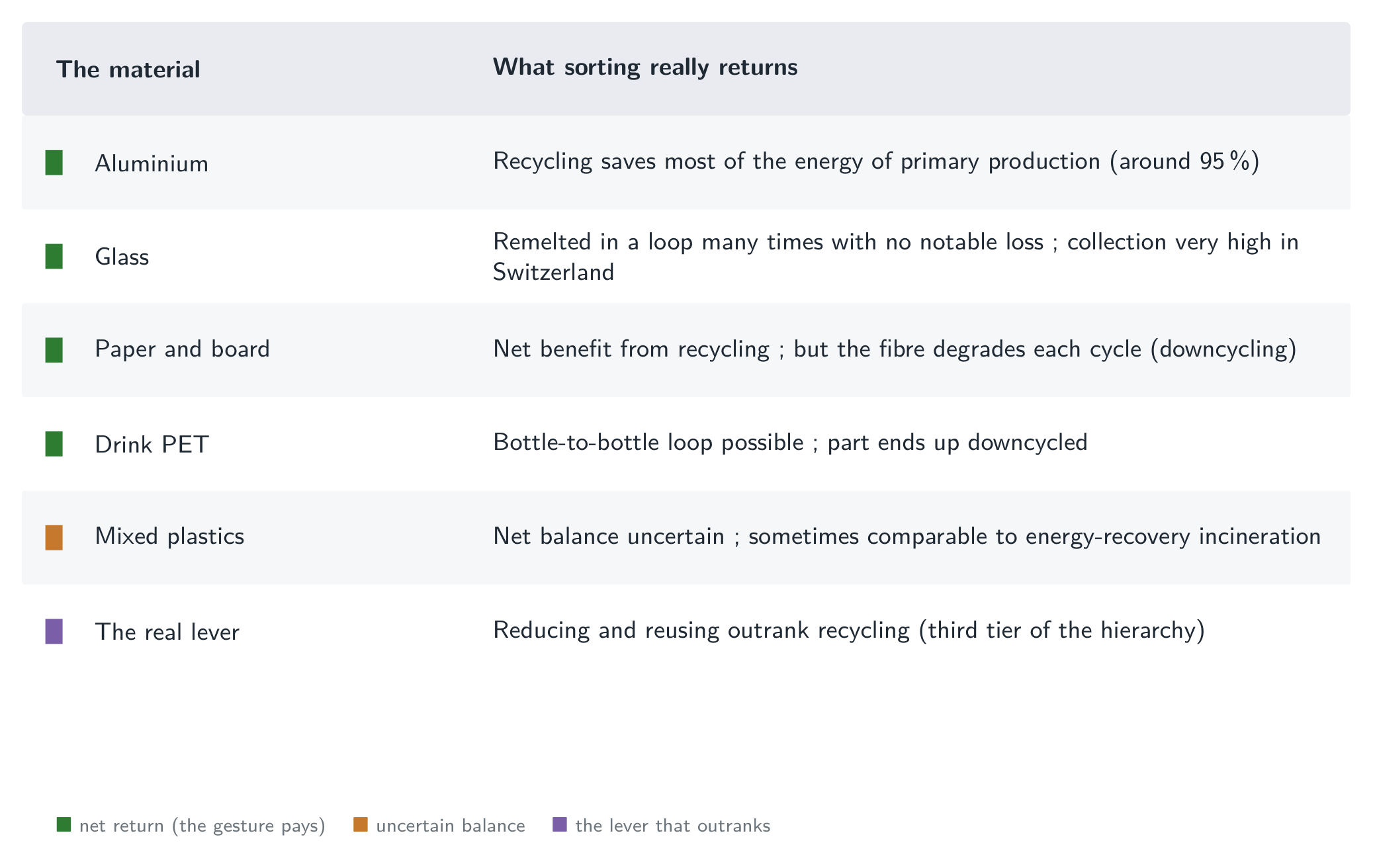
Aluminium is the textbook case, and it is decisive. Producing it from ore swallows enormous amounts of electricity, in an electrolysis among the most energy-hungry of industrial processes; remelting it from sorted cans calls for a fraction of that. Recycling aluminium saves most of the energy of primary production, on the order of ninety-five per cent, an order of magnitude confirmed by independent life cycle assessments, even if the exact figure varies with the electricity mix and the calculation boundary retained (International Aluminium Institute 2020; Olivieri et al. 2006). This loop is all the more favourable in that the metal remelts a great many times without intrinsic loss of quality, which makes it a near-ideal closed-loop recycling (Olivieri et al. 2006; International Aluminium Institute 2020). Collection rates for aluminium packaging are moreover high in Switzerland and in several European countries, even if they stay short of the whole (Olivieri et al. 2006; IGORA / Cooperative pour le recyclage de l’aluminium, Suisse 2023). For a can, the choice between the bin and the grey rubbish is therefore far from trivial: it is the difference between a thrifty remelt and a lost resource that will have to be torn from bauxite again.
Glass follows a kindred and equally favourable logic. It remelts in a loop a great many times without notable loss of quality, replacing the sand, soda and limestone that would otherwise have to be extracted and heated (Vellini and Savioli 2009), and its collection reaches a very high level in Switzerland, on the order of nine tenths (Vellini and Savioli 2009; VetroSwiss / OFEV 2023). Every tonne of cullet that returns to the furnace is a tonne of virgin raw material spared, and a little melting energy less. The benefit nonetheless stays sensitive to context, and this must be said to remain honest: sorting by colour, contamination and above all the transport of cullet, which is heavy, can erode the advantage, and a share of the collected glass is downcycled into aggregate or insulation rather than looped back into packaging (Vellini and Savioli 2009). The gesture pays, provided one does not imagine it without costs or losses.
Paper and board also have a balance that favours recycling, as long as it is not idealised. Recycling a fibre avoids felling and processing new wood, but that fibre shortens and degrades with each pass: paper is not recycled indefinitely (Merrild et al. 2008). The degradation bounds the number of cycles to a few, so that the channel needs a continuous input of virgin fibre to hold, and a world with no trees cut at all is physically impossible (Merrild et al. 2008). This limit granted, the recycling rates of paper and board are among the highest in Switzerland and in Europe, which makes them one of the clearest successes of selective collection (Merrild et al. 2008; Office federal de l’environnement (OFEV), Suisse 2023).
Ferrous metals deserve a mention at last, for they may be the most surely recovered stream of all. Steel and tinplate recycle in a loop and separate easily by magnet, including in incineration residues, which catches them even when they have not been sorted (Šyc et al. 2020). A can left in the grey rubbish is not quite lost, for the magnet will recover it after the furnace. For them, a sorting mistake costs less than elsewhere, and that is a good reason not to make an obsession of it.
4. Where the doubt is legitimate
Here the defeatist intuition touches something true, and it must be acknowledged plainly, on pain of slipping into the triumphalism just criticised. Not all plastics resemble aluminium, and the picture darkens as soon as one leaves the noble materials.
Drink PET holds an instructive intermediate position, halfway between success and disappointment. It allows a bottle-to-bottle loop whose life cycle assessments show the benefit (Chairat and Gheewala 2023), and its collection is high in Switzerland, carried by a dedicated network in shops and public spaces (Chairat and Gheewala 2023; PET-Recycling Schweiz 2023). The nuance matters: recycled PET never quite loops fully, because sanitary requirements, yellowing and the degradation of the polymer chains limit the reincorporable share and impose a top-up of virgin material (Damayanti and Wu 2021). The loop exists, it is real, but it leaks slowly, so that a bottle at best feeds a few subsequent bottles before leaving the circuit.
The figure that frames the debate is a global one, and it is severe. Across the planet, only about nine per cent of plastic waste is actually recycled, the rest being incinerated, landfilled where allowed, or dispersed into the environment (Geyer et al. 2017; OECD 2022). This figure calls for precision, and it is precisely because it is so striking that it must be framed: it is global, it aggregates very unequal systems, and it does not describe Swiss performance on a well-separated stream like PET. But it says a useful truth, that at the scale where plastic pollution plays out, recycling is far from the massive solution we imagine, and that we will not sort our way out of the problem.
For the mixed plastics of packaging, the doubt bears on the balance itself, no longer only on the rates. When you compare over the whole life cycle the mechanical recycling of these plastics with their incineration with energy recovery, the advantage of recycling becomes uncertain and depends heavily on the quality of the recyclate obtained (Jeswani et al. 2021). A large part of this gap is explained by the nature of the packaging: multilayers, composites and soft films, designed to preserve food, resist mechanical recycling, sometimes to the point of impossibility (Kaiser et al. 2017). The crisp bag or the aluminised tray are not lazy materials, they are assemblies too clever to be cleanly undone. And the problem grows faster than we resorb it, since world plastic production grows more quickly than recycling capacity, so that recycling alone does not reverse the curve (OECD 2022).
It is in this context that one must place the discourse that “plastic recycling is a lie”, often hurled as a knockout argument. It has a real historical basis: the industry promoted recycling as a solution while knowing its economic and technical limits, which justifies part of the suspicion (Geyer et al. 2017). Conceding this point is not surrendering to cynicism, it is staying symmetric. This finding, American and centred on plastic, does not however extend as-is to all materials nor to a Swiss system of energy-recovery incineration, and one would be wrong to bury aluminium with the food film. Recycling does not, moreover, settle the most diffuse part of the problem: the fragmentation of plastics into microparticles continues in use and at end of life independently of the recycling rate, beyond the reach of the bin (Cole et al. 2011). On this terrain, sorting can simply do nothing.
One must draw the consequence without dramatising it. For these difficult plastics, dropping the packaging in the bin is often a matter of principle rather than of measurable gain, and the energy-recovery incineration that Switzerland practises is not, for them, the scandal one imagines (Jeswani et al. 2021). This does not invite ceasing to collect them where a serious channel exists, but ceasing to expect from the recycling of mixed plastics what it cannot give, and shifting the demand onto the reduction of these packagings upstream (OECD 2022). The doubt, here, is not cynicism, it is exactness, and it targets a precise stream without contaminating the judgement one passes on the others.
5. Incineration, without angelism or trial
Since the alternative to sorting, in Switzerland, is incineration, it must be judged honestly, and the balance tips on both sides. Burning fossil-origin plastic emits fossil carbon dioxide: energy recovery is therefore not climate-neutral, even if it avoids, where landfill remains the alternative, the methane emissions that a landfill releases, a counterfactual that does not hold for Switzerland, where the landfilling of combustibles is banned (Turconi et al. 2011). Incineration is neither the absolute evil of the ecological imagination, nor the equal of recycling; it is a lesser evil for some fractions and a real loss for others.
On the climate, the order of the options is largely confirmed by life cycle assessment, and it matches intuition. Material recycling generally does better than incineration for materials with high embodied energy, metals and paper foremost, while the gap narrows for some plastics whose calorific value makes them an acceptable fuel (Turconi et al. 2011; Merrild et al. 2008). One must still add a nuance that works the other way and is often forgotten: part of the unsorted metals is recovered in the bottom ash after combustion, by magnetic and eddy-current separation, which attenuates, without cancelling, the loss of a metal thrown into the grey rubbish (Šyc et al. 2020). The system catches part of our negligence, without that dispensing us from avoiding it.
This caution on both sides is not lukewarmness, it is required by the matter itself. Life cycle assessments of end of life depend on the local context, the electricity mix, transport distances and outlets for the recycled material, to the point that serious studies sometimes reach opposite conclusions depending on the country (Turconi et al. 2011). A single bottle does not have the same balance in Geneva, fed by a largely hydraulic grid, and in a coal-powered region. There is no universal verdict on the best fate of a waste, only situated answers, which should make one wary of any over-sharp claim, including our own.
This relativism nonetheless authorises no laziness of judgement. Saying that the balance depends on context does not amount to saying that everything is equal: aluminium gains from being recycled almost everywhere, the soft film almost nowhere, and it is between these two certainties that the grey zone lies where context decides (Turconi et al. 2011). The right posture keeps at a distance both the universal verdict and the shrug, and holds attention on the particular case, the only scale at which the question gets a true answer.
6. The systemic and the individual do not oppose each other
Let us return to the argument that often closes the discussion, now that we can treat it on the evidence rather than suffer it. One hears that a hundred companies would be responsible for seventy-one per cent of emissions, hence that individual behaviours would be derisory. The figure is real, but it says something other than what it is made to say: it comes from a report on fossil-fuel producers, and it includes the emissions linked to the use of those fuels by consumers (Griffin, Paul and CDP 2017; Ivanova et al. 2015). It describes a chain, from the oil well to the exhaust pipe, and the demand that feeds it is not absent from it. Counting emissions on the side of those who extract does not prove that those who consume are blameless.
This in no way denies the weight of the upstream, which is real and structuring, and indeed the opposite. The most powerful lever lies in product design and extended producer responsibility, which act on recyclability and recycled content well beyond the gesture of sorting (Joltreau 2022). A package designed to be recyclable does more, on its own, than a thousand meticulous sorters facing a package that is not. But acknowledging this weight does not degrade the individual gesture, and opposing them is precisely the error. The two scales reinforce each other rather than compete, for demand, social norms and the vote orient the rules and the supply, so that giving up the gesture in the name of the systemic also weakens the systemic lever. Defeatism bites its own tail: it invokes the system to discourage what, among other things, moves the system. There remains an objection one will not brush aside with the back of the hand: sorting can also serve as an alibi that shifts onto the consumer a responsibility that falls first on the producer. This question, political and quite real, differs from that of the material balance and belongs to the examination of producer responsibility set aside at the outset, not to a defusing in passing.
One can put it by reversing the objection. If individual behaviours truly weighed nothing, manufacturers would not spend so much effort steering them, and the rules framing packaging would not be the object of such intense lobbying (Joltreau 2022). This relentlessness does not prove the environmental weight of each gesture; it only indicates that behaviours weigh enough for one to seek to steer them, the stake bearing moreover on packaging rules rather than on the balance of a single can. The citizen who sorts, demands and chooses is not the weak link of the device, but one of its restoring forces, on the double condition of not overrating this gesture alone and of not taking it as sufficient.
7. The psychology of the gesture
Sorting also engages mental springs better known in advance, for they can turn good will against itself. Performing a small virtuous gesture can, in some cases, soothe the conscience to the point of slackening the effort elsewhere, by a moral licensing effect where the well-filled bin serves as an alibi for heavier choices; the effect is however neither automatic nor universal, and a positive carry-over exists just as much, where a first gesture calls for others (Truelove et al. 2014). In the same vein, the rebound effect can erode part of the gain, when one consumes more because one feels covered by one’s virtue, without erasing it as a rule (Sorrell et al. 2009). Sorting obviously does not make anyone bad, but the most visible gesture is not necessarily the most effective, and it can anaesthetise the attention one would otherwise pay to reduction.
Another flaw concerns the very quality of sorting, and it takes the opposite of excess zeal. Wishcycling, that reflex of slipping a non-recyclable object into the bin just in case, contaminates the streams, weighs down the rejects at the sorting centre and degrades the recyclate: sorting more is not always sorting better (Auer et al. 2023). The poorly rinsed yogurt pot or the hard plastic toy thrown into the paper bin cost more than they bring. The clarity of the instructions then weighs as much as good will, since simple rules and incentive systems like the deposit on containers markedly improve collection, where complexity discourages it (Picuno et al. 2025). The right gesture is designed and learned, it is not improvised by a surplus of good conscience.
These springs do not condemn sorting, they only invite practising it with lucidity. To know the moral licensing effect is to guard against trading a small gesture for a great renunciation; to know wishcycling is to prefer accurate sorting to abundant sorting (Auer et al. 2023). Good will stays precious, it is its routing that calls for attention, and an informed sorter does more good than a zealous sorter who contaminates the streams and absolves himself cheaply (Truelove et al. 2014).
8. The hierarchy, and the real lever
A framing fact finally puts sorting back in its proper place in the order of priorities, and it may be the most important of the text. The European waste hierarchy ranks prevention and reuse above recycling, so that sorting for recycling occupies only the third rank of five, behind producing less and reusing (Union europeenne 2008; Gharfalkar et al. 2015). This order is neither arbitrary nor ideological: avoiding producing a waste generally saves more resources and emissions than recycling it afterwards, because one spares at a stroke the whole phase of production, extraction and transport (Gentil et al. 2011). The best-treated waste remains the one that does not exist. Reuse slips between the two, and a reused package can beat a recycled one environmentally, provided the number of reuses and the transport distances play in its favour (Hitt et al. 2023). The deposit bottle that goes back twenty times to the same place wins; the one that crosses the country at each rotation loses its advantage.
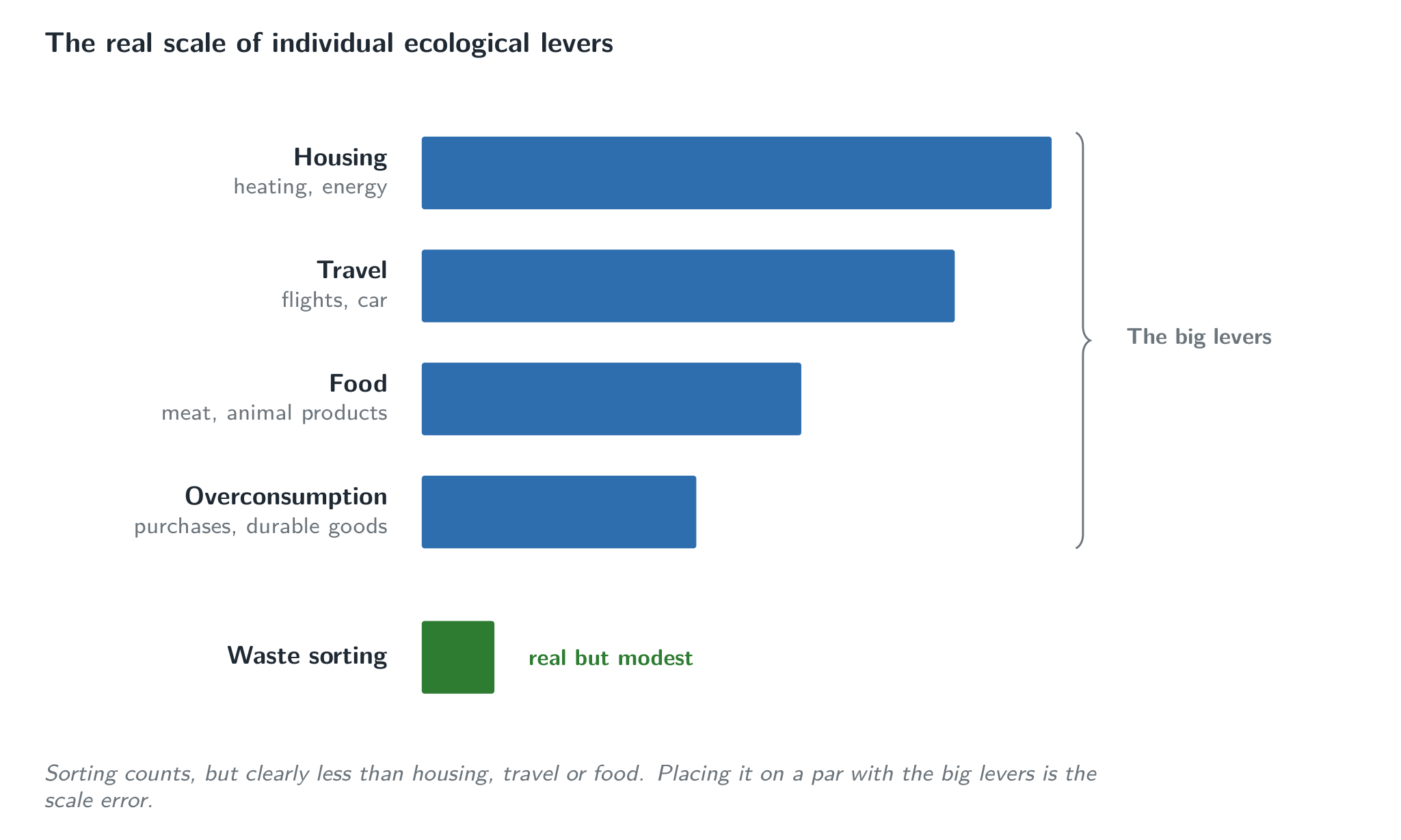
Cost finally deserves to enter the balance, for it lights up the inequality of the gesture better than any speech. Selective collection and sorting have a price, borne by households and producers, justified when the material offers a net return and more debatable when the environmental benefit of recycling stays low (De Feo and Polito 2015). Spending to recover aluminium is a good calculation; spending as much for a plastic that will end up burned is much less so. And one must keep a sense of proportion: even done well, the sorting of household waste represents only a modest share of an individual’s footprint, behind transport, heating and food, which situates it without disqualifying it (Ivanova et al. 2015). From all this a simple line of conduct emerges: sort what has a net return, aluminium, glass, paper, PET, metals, do not feel guilty about the streams with an uncertain balance, and carry the effort upstream, where it weighs most, without believing for all that that what is beyond the individual makes the gesture null.
This conduct has the advantage of being sustainable over time, where guilt ends up exhausting itself. One sorts better and longer when one knows why one does it, material by material, than when one obeys an undifferentiated injunction that puts the aluminium can and the composite tray on the same level (Ivanova et al. 2015). Making prevention the first reflex and sorting a targeted gesture is putting the effort where it returns most, without abdicating any of the demand or settling for good conscience (Gentil et al. 2011).
9. Conclusion: shifting the reading
The initial doubt framed the question in all-or-nothing terms: either the gesture saves the world, or it serves no purpose. Reality lies in an in-between that is anything but lukewarm, and that is precisely what symmetry has taught us to see: sorting keeps a real but unequal value, strong for a few materials, doubtful for others, and always second to reduction. The answer is not made to flatter, it is made to guide, and guiding supposes that one accepts different verdicts depending on the matter.
It is a portable tool, to bring out each time the bottle hesitates over the bin. Rather than asking “is it worth anything”, ask “which material is it, and what is the alternative to my gesture here”. For the aluminium can, the glass, the newspaper, the PET bottle, the answer leans clearly to the good side; for the soft plastic film, it hesitates, and it is no tragedy to know it. The day you sort knowing the real value of each gesture, you no longer sort out of guilt or out of faith, but knowing, material by material, what it changes, and that knowledge is worth more than the good conscience it replaces. Sorting then becomes an act of knowledge as much as of civic duty, and it is on that account, modest and lucid, that it regains its full meaning: an informed decision one can hold over time without paying oneself in words or lying about its reach.